June 13, 2026

24/7 CNC Machine Shop Houston

Upwards Of 30% of Texas-made aerospace and energy hardware now depend on CNC milling. This change has turned Houston an important center in high-accuracy manufacturing. Nearby producers and design engineers often choose local machining partners to reduce lead times and protect quality on high-value assemblies.


The following overview breaks down CNC milling in Houston and its practical strengths. It shows how Houston machining services achieve tight tolerances for diverse applications, from energy production to biomedical products. When you are looking for a machine shop Houston partner for a single test part or high-volume manufacturing, Houston offers a range of options. Shops here provide 3-, 4-, and 5-axis mills, turn/mill equipment, and EDM support.

Lowrance Machine is an experienced supplier of high-accuracy manufacturing in the area. Contact the team through www.lowrancemachine.com to review your part specifications, alloy requirements, and production timing with an experienced provider equipped for demanding prototype-to-production programs.

Important Points

  • CNC milling in Houston is central to Houston-area aerospace, energy, and biomedical supply systems.
  • Machining services Houston include high-capability three-, four-, and five-axis milling plus wire EDM, probe EDM, and live-tool turning.
  • Choosing a regional CNC machining partner can reduce delays and simplify project coordination.
  • The Lowrance Machine team handles small-run and scalable production requirements with certified quality systems.
  • Compare shops on machine capacity, materials expertise, and room to grow from prototype to volume.

Why Houston Is A Hub For Precision CNC Milling And Industrial Machining

Houston’s broad industrial base create a steady demand for precision parts. Businesses across energy, petrochemical, aerospace, and medical markets require parts with controlled dimensions and documented history. The local need supports local machine shops to provide prototype parts, complete assemblies, and recurring production work.

Over 6,000 manufacturers in the Houston area create a strong supplier base. Machine shops can collaborate with nearby subcontractors for finishing, heat treatment, and inspections. The local ecosystem reduces delivery delays, supporting quick engineering revisions for high-detail components.

Houston is an important center for oil and gas equipment production, with strong connections to pipelines and the Port of Houston. Its logistics benefits facilitate the movement of oversized and heavy parts to global markets. That logistical advantage supports both one-off prototypes and full production programs.

The Johnson Space Center and a strong aerospace cluster of 150-plus companies drive demand for flight hardware and test fixtures. CNC Milling specialists in Houston handle consistent work in producing aerospace brackets, test fixtures, and biomedical parts. These projects demand accurate finishing and complete inspection records.

The area’s manufacturing support system enables larger machining programs in Houston. Proximity to metal suppliers, toolmakers, and inspection facilities cuts transit delays. This efficiency is especially important to energy and life-science markets, where part qualification is swift.
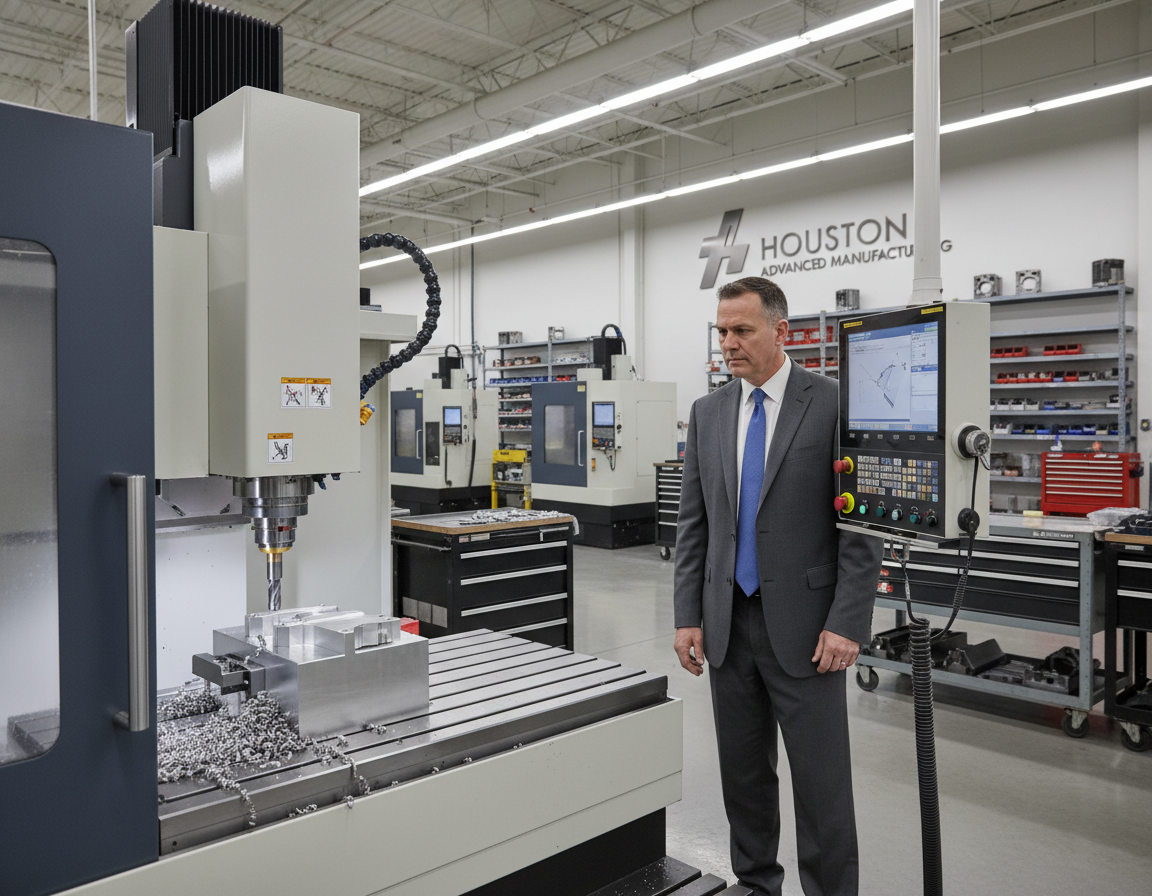
Manual Machining Services Houston

CNC Milling In Houston

CNC milling converts engineered files into precise metal and polymer parts. It uses computer-guided three-, four-, and five-axis mills. Local CNC facilities use high-efficiency cutting paths and fast spindle systems to achieve accurate dimensions and refined surfaces. That matters for regulated and heavy-industry components that need accuracy and small-feature control.

More capable CNC shops pair five-axis equipment with rotary support. That arrangement makes possible complex contours to be produced with fewer setups. This minimizes part handling and shortens lead times for prototypes and production runs. Live-tool lathes plus fast milling allow shops to machine compound features and close-radius details with precision.

CNC Milling Definition And Core Capabilities

CNC milling uses programmed motion to machine stock with controlled cutters and end mills. Three-to-five-axis control supports combined tool movement on multiple controlled axes. That makes possible the machining of undercuts, deep pockets, and compound angles in fewer setups. CAM strategies like adaptive clearing and trochoidal milling support material removal and tool longevity.

Typical precision shops in Houston aim for tolerances suited to aerospace and medical standards. Precision production often depends on stable spindle platforms, thermal controls, and in-process probing for real-time dimensional verification. Those controls help ensure parts meet repeatability and dimensional stability across repeat runs.

Common Equipment And Capacity In Houston Machine Shops

Houston CNC machine shop facilities deploy machines from major machine-tool manufacturers such as Mazak, Haas, and DMG MORI. Machines such as DMG MORI NVX and NLVX mills enable 4-axis work with rotary tables for medium-to-large parts. Larger machining-center investments help shops move from early prototypes to production volume.

Oversized machining platforms machine large and heavy parts for subsea parts and pressure housings. Capable providers invest in machines that retain accuracy at size, using robust platens and gantry designs. The larger work envelope keeps more large-part work in-house and maintains local inspection control.

Machining Capability Typical Hardware Practical Advantage
Three-, four-, and five-axis milling DMG MORI and Mazak multi-axis platforms Complex geometry in fewer setups
Large-format machining Large bridge mills and gantry systems Accurate machining of oversized parts
Live tooling & turning Mill-turn equipment and live-tool lathes Combined mill/turn operations; fewer handoffs
High-speed spindles High-speed spindle units Better surface finish and faster cycle times
In-process probing On-machine measurement and Renishaw probes Immediate verification of critical features

Related capabilities in a full-service CNC machine shop Houston include CNC lathe machining Houston for shaft, bore, and diameter work. Using both turning and milling cuts handling between machines and compresses the complete production cycle.

Choosing a Houston-area provider with reliable equipment and multi-axis capacity helps engineers meet tight specs and accelerate project timelines. Skilled setup, tooling strategies, and modern equipment provide the backbone of competitive CNC milling Houston services.

Precision Manufacturing Services Offered By Lowrance Machine

Lowrance Machine supports moving projects from prototype through production, with attention to precision, timely delivery, and documented quality. The shop provides a mix of CNC and manual capabilities, supporting low-volume work, intricate parts, and controlled industries. The shop combines CNC automation and manual craftsmanship to meet close tolerances and deadline pressures.

Comprehensive CNC Milling And Machining Services

As an experienced machine shop Houston provider, this machining partner offers milling, turning, and complex assemblies. The shop handles advanced milling, turn/mill operations, and long-bed turning for extended parts. Electrical-discharge machining support enable precise internal features that are hard to reach with cutting tools.

Deep-hole gun drilling and BTA drilling support diameters from one-quarter inch through 3.75 inches and deep bores for specialized hole-making. Internal value-added services include thermal processing, coatings, and painting so parts arrive assembly-ready. These value-added finishing steps shorten turnaround and reduce the burden of coordinating outside vendors.

Manual machining services in Houston are useful for one-off tools, fixtures, and short runs. Skilled machinists manage fit checks, assembly adjustments, and custom modifications that complement CNC production. This mix of automated and manual processes helps with rapid prototyping and smooth transition to production.

Quality Systems And Certifications

Lowrance Machine’s quality approach focuses on documented processes and strong inspection practices. The team uses coordinate measuring, statistical tracking, and EDM-related inspection to support consistent results. That inspection structure support customers in aerospace, medical, and heavy-industry markets that depend on traceable records.

Regional machining providers commonly reference recognized quality standards such as ISO 9001:2015 and AS9100D to demonstrate their quality-management discipline. Midway Machine is an example of a nearby machine shop holding ISO 9001:2015 and AS9100D certification, which illustrates what many customers expect from precision suppliers. Lowrance Machine aligns processes to comparable industry expectations to meet supplier and customer audit requirements.

Support Area Capabilities Customer Advantage
CNC Milling multi-axis milling, high-RPM spindles, and hard-metal strategies Detailed shapes, close tolerances, and repeatable production
CNC Turning And Live Tooling long-bed lathe work, multi-turret machines, and live-tool milling Less handling and stronger production efficiency
Wire EDM And Probe EDM Wire EDM, probe EDM verification for internal features Precise detail with minimal burrs
Gun And BTA Drilling Gun/BTA drilling 0.25″–3.75″, extended length options Repeatable long holes and better part performance
Manual Support Work manual fitting, fixture work, and assembly checks Fast prototypes and practical adjustments
Metrology & QA CMM, SPC, in-process probing, documented inspection reports Documentation for regulated sectors and less rework
Finishing And Added Services Heat treat, plating, powder coat, painting, zinc phosphating Parts ready for assembly, fewer subcontractors

Selecting a machining partner that combines complete Houston machining services with disciplined inspection controls reduces delivery delays and reduces project risk. The Lowrance Machine team combines modern CNC machine shop Houston technology with experienced machinists to handle prototypes, production runs, and regulated supply chains.

Materials And Industries Served By CNC Machine Shops In Houston

Machine shops in Houston work with a large variety of metallic materials and specialty plastics. They meet demanding tolerances and severe service conditions. By pairing hands-on skill with CNC automation, they deliver parts for both rugged sectors and high-accuracy markets.

Here’s a practical overview at typical materials plus the industries that depend on them.

Materials Houston Shops Commonly Machine

Strength-focused steels are important in energy projects, forming pressure housings and valve bodies. Stainless steel is used for its resistance to corrosion and easy cleaning.

Aluminum, brass, bronze, and copper are used for components needing conductivity, weight savings, and practical strength. High-nickel alloys withstand subsea, refinery, and high-temperature settings in subsea and refinery settings.

Engineering plastics like PEEK, Delrin, and UHMW are machined into parts needing wear control, reduced friction, and chemical resistance. Such materials suit assemblies requiring lighter parts or chemical compatibility. Manual machining in Houston allows for manual adjustment of difficult plastics and nonferrous materials, supporting the final fit and feel.

Industries Served And Example Applications

Oil and gas companies need flow-control components, offshore hardware, and large housings. Those components require rugged machining, straightness control, and complete inspection records.

Defense and aerospace customers order test fixtures, brackets, and flight-related hardware with strict expectations. CNC Milling Houston providers ensures controlled GD&T requirements on complex aerospace parts.

Medical device and biomedical manufacturers use approved metals and engineered plastics. These customers also need controlled cleaning and inspection processes. A dependable Houston machine shop provides batch traceability and stronger documentation for regulatory compliance.

Marine, agriculture, and general industrial production also depend on Houston machining services. Their applications call for corrosion-resistant fittings, pump components, and custom tooling. Midway Machine’s wide range of materials meets regional demand, spanning steel grades, aluminum, copper-family alloys, nickel alloys, and specialty plastics. Such materials serve aerospace, biomedical, subsea, energy, marine, and agriculture applications.

Equipment And Capabilities That Improve Lead Time And Quality

Modern shops in Houston are improving turnaround times and component quality with modern equipment plus cleaner production flow. Fast multi-axis mills, heavy-duty horizontal centers, and extended-bed lathes eliminate capacity bottlenecks. That combination, combined with on-site finishing plus metrology, creates more predictable delivery and quality for customers across several markets.

Advanced Milling And Turning Equipment

Fast four-axis and five-axis mills with rotary tables allow teams to machine compound contours in one setup. The result is shorter machining time and minimizes errors. These strengths are important to Houston CNC milling providers catering to industries with strict tolerances.

Large horizontal machining centers, like the Okuma MB-8000H platform, machine large, dense workpieces. Such systems can support up to 4,400 lbs and provide large work tables. This can mean a one setup can avoid several smaller machine setups. Long-bed turning Houston capacity is provided by lathes like the Okuma LB line, machining extended shafts, tubes, and housings up to hundreds of inches between centers.

Modern lathes with live tooling supports milling operations on turning centers. This reduces part handling, reduces cycle time, and helps prevent setup mismatch. Shops specializing in CNC lathe machining Houston use live tooling to produce mixed-geometry parts in fewer operations.

Production Efficiency And In-House Finishing Options

Shop throughput improves when CNC Milling Houston equipment is paired with streamlined workholding and automated tool changers. Pallet systems and gantry loaders help machines stay in cycle while technicians stage the next job. The outcome is better output and more predictable scheduling.

On-site finishing cuts outside queue delays. Common options include heat treat, plating, powder coat, painting, and zinc phosphating. A one-stop model for machining services Houston allows customers to receive installation-ready assemblies without coordinating multiple vendors.

Production Capability Example Equipment Typical Benefit
Fast five-axis milling DMG Mori DMU and Haas UMC Detailed geometry with cleaner surfaces
Large horizontal machining Okuma MB-8000H Large heavy-part machining with stable cutting
Long-part CNC turning Okuma LB series, Doosan Puma Efficient shafts and housings over long lengths
Live-tool lathes Live-tool Okuma LB 45 III Fewer operations for mixed-feature parts
In-house finishing powder coat booths, plating lines, and heat-treat ovens Faster delivery of finished parts and consistent quality

Selecting providers with this range of equipment reduces turnaround and strengthens repeatable quality. For projects requiring both precision and speed, partnering with shops that offer CNC lathe machining Houston, CNC Milling Houston, machining services Houston, and long-bed turning Houston delivers significant gains in schedule and product quality.

Choosing The Right Machining Service In Houston: What To Look For

When choosing a provider, connect the supplier’s equipment to your component requirements. Verify the machine envelope, weight capacity, and available axes can handle your components. This matters most with oversized or heavy parts, where machines like large gantry mills or long-bed lathes are practical. Confirm the vendor’s ability to perform multi-axis milling for compound surfaces and turn/mill work for combined operations.

Then review the vendor’s process experience. Look for wire and probe EDM, gun/BTA deep-hole drilling, and manual machining services Houston for unique or repair tasks. A shop with this process mix shows versatility in both prototype and production environments.

Review the inspection systems and metrology assets in place. Look for ISO 9001:2015 or AS9100D certification and CMMs, optical comparators, and calibrated gauges on site. Midway Machine’s certification profile reflects the area’s aerospace-level quality expectations.

Consider the vendor’s communication speed and estimating accuracy. Fast and thorough estimates that outline tooling, setup times, and inspection steps suggest solid front-end engineering and quoting discipline. A vendor willing to support prototypes and scale to production suggests a stronger ongoing manufacturing partner.

Prioritize single-source services to streamline lead times and costs. In-house heat treat, plating, and finishing lower outside-vendor risk and make scheduling easier. That model aids in controlling schedules for CNC Milling Houston and related machining work.

Use a brief evaluation list to measure each candidate’s equipment and capacity. Verify machine envelope, horsepower, and axis setup and whether they run a complete CNC machine shop Houston operation plus manual machine-shop services in Houston for mixed production needs.

To finish the evaluation, emphasize consistent updates and traceable records. Frequent updates, inspection documentation, and one clear contact make complex jobs easier to manage. Selecting a Houston machine shop should feel like adding an engineering partner and not merely hiring a vendor.

Machine Shop Houston Project Cost, Lead Time, And Scalability

Understanding the cost and lead time is important to technical and procurement teams. Price and timing are shaped by materials, geometry, tolerance, and finish requirements. Accurate specifications are critical for clear supplier estimates.

What Affects Price And Timing

Choice of material can greatly influence both price and cycle time. For instance, aluminum is often faster to machine than stainless steel, which can increase tool wear and cycle time. Intricate shapes and deep internal features also lengthen machining time. Additional finishing steps like anodizing, deburring, and specialty finishes extend delivery dates and increase handling costs.

Quantity strongly changes unit cost. One prototype incurs programming, setup, and planning costs. By comparison, production lots divide setup expense across more pieces. High-volume work supports custom workholding and optimized tooling, reducing cycle time. Complete models, drawings, and tolerance notes make estimates more accurate and speed up commitments from suppliers.

Scaling From Prototype To Production

Moving machining from prototype to volume requires consistent equipment and processes. Providers like Lowrance Machine use larger mills and advanced CNC machines. This investment ensures quality as volumes increase, reducing risk in moving from prototypes into production.

Cost-saving strategies include live-tool machining, better toolpaths, and purpose-built fixtures. Those methods reduce handling and cycle time per piece. Selecting materials and surface processes that avoid extra finishing cuts overall cost. Houston CNC milling capability, when applied smartly, can remove some follow-up work by completing features in a single setup.

Supplier quoting and schedule commitments are strengthened by clear technical data. Provide flat CAD/CAM files, clear tolerance callouts, and openness to practical process improvements. Good communication with a shop reduces back-and-forth, leading to clearer delivery dates and better cost control.

Project Driver Effect On Price Impact On Lead Time Mitigation
Material choice, such as aluminum vs stainless Aluminum is usually cheaper to machine; stainless may raise tool and run costs Harder materials often increase machining time Select an easier-machining alloy with similar properties
Geometry and feature complexity More complex raises programming and run cost Complex features can add production time Consolidate work with Houston multi-axis milling
Tolerances and finish Close tolerances raise inspection and possible rework expense Precision work requires slower cycles and more QA time Balance tolerance to function; limit fine finishes where possible
Order volume Higher volume lowers unit cost via amortized tooling Production lots add planning time but improve per-part throughput Plan runs to benefit from tooling amortization
Secondary processes Heat treat and plating can add outside-vendor costs Each operation adds transit and queue days Choose materials and finishes that minimize extra steps
Manufacturing optimization Optimized CAM and workholding lower unit cost Optimized processes cut cycle time Use machining services Houston expertise to improve CAM and fixturing

Final Thoughts

The Houston manufacturing market is well suited to CNC Milling Houston projects needing precision and speed. Local shops use high-capability machinery from brands like major builders such as DMG MORI and Okuma. These shops may also support long-bed lathes, live tooling, EDM, and in-house finishing. That capability mix supports a faster shift from prototype to production.

When choosing a Houston CNC machine shop, check part specs, volumes, and inspection plans. Ask about certifications like AS9100D or ISO 9001. Transparent pricing and delivery expectations are important for preventing delays. They help ensure the chosen shop can grow with your needs.

When you need machining services in Houston that include assembly support and finishing, evaluate the whole workflow and the shop’s communication. Lowrance Machine can support the full workflow from prototype to production. They offer technical reviews and quotation support to meet your part tolerances and delivery needs.

Cosmetic Surgery Marketing Company

In the current competitive market, knowing how to attract the right patients is essential for any medical practice. Cosmetic surgery requires a specialized marketing approach because potential patients often research carefully before deciding. This guide shows how stronger online visibility can help your practice produce more patient enquiries, consultation requests, and booked appointments.


Many plastic surgeons discover that traditional marketing methods are no longer enough. Today’s patients often depend heavily on search engines, reviews, websites, and online content before choosing a surgeon. By using a targeted strategy, your practice can attract high-intent patients who are already looking for procedures like facelifts, rhinoplasty, breast augmentation, or liposuction.

Statistics also show that many marketers view organic search as one of the strongest channels for return on investment. That reinforces the need to prioritize a visible, trustworthy, and well-optimized online presence. As you read further, you will discover useful ideas for improving your website, developing engaging content, and applying more advanced digital marketing strategies.

Why Industry Specialization Matters In Plastic Surgery SEO

Plastic surgery is highly personal, so patient engagement requires a more specialized and thoughtful approach. Generalist marketing agencies may struggle to address the unique concerns, expectations, and decision patterns in this industry. They may lack the deeper understanding of how patients evaluate elective procedures that involve confidence, appearance, trust, cost, and long-term outcomes.

Understanding cosmetic surgery patient psychology is essential. For example, someone searching for “facelift surgery” late at night may be in an emotional, aspirational research phase. In contrast, someone searching in the morning may be closer to scheduling, calling, or comparing surgeons seriously. This distinction matters when creating effective marketing strategies.

Trust-building takes longer in plastic surgery than in many other industries. Prospective patients commonly spend weeks or months reviewing credentials, galleries, testimonials, pricing, and consultation options before making contact. They need confidence that the surgeon, facility, staff, and results match their expectations. For this reason, trust is not just a branding issue but a core part of SEO, content, and lead generation.

Specialization also involves recognizing that different patient groups need different messages, proof points, and educational content. For example, a younger breast augmentation patient may use different search terms, concerns, and social platforms than an older facelift patient. Tailored marketing strategies are necessary to meet these varied needs.

Regional and demographic differences make the market even more complex. Practices in saturated urban markets such as Los Angeles or New York face different pressures from practices in emerging suburban areas. The SEO strategy should adjust to the local market, patient demand, competitive density, and procedure mix.

Expertise, authoritativeness, and trustworthiness are especially important in plastic surgery SEO. Google holds medical websites to higher standards because the information can affect users’ health and financial decisions. A specialized plastic surgery SEO firm tracks industry trends and competitor movement to adapt strategies based on real-world practice data.

In conclusion, choosing a partner focused on plastic surgery marketing helps align every part of the SEO campaign with patient expectations, search engine requirements, and practice growth goals.

SEO For Cosmetic Surgery Practices

Setting Clear Goals: Defining Successful Cosmetic Surgery Lead Generation

Modern healthcare practices need strong patient engagement to compete and grow. In plastic surgery, defining a quality lead versus a potential lead is especially important. Understanding this difference helps practices measure real campaign success.

For instance, a potential lead might simply be browsing general information about tummy tuck recovery or cost. A quality lead, however, is usually location-relevant, financially prepared, procedure-specific, and ready to request a consultation. Knowing the difference helps practices create practical goals and evaluate campaigns more accurately.

Defining Quality Leads Versus Potential Leads

Understanding search intent is central to identifying lead quality. A query like “what is recovery like after rhinoplasty” suggests research mode, while “best rhinoplasty surgeon near me” suggests stronger commercial or appointment intent. These insights can guide your marketing strategies effectively.

Measuring ROI In Cosmetic Surgery SEO Campaigns

Measuring SEO return on investment requires tracking several metrics. Important indicators include organic traffic growth, keyword ranking gains, and contact form submissions. Ultimately, the goal is to increase booked consultations and procedures.

SEO goals should connect directly to the practice’s revenue and growth targets. Every marketing dollar should contribute to measurable business outcomes instead of vanity metrics such as page views. A specialized agency can connect organic search activity to calls, forms, booked consultations, and patient acquisition through proper attribution.

Strong lead generation is not only about getting more visitors. It is about attracting patients who live in the right market, can afford the procedure, and are interested in the services the surgeon performs best. Because plastic surgery has a longer sales cycle, patience is needed when assessing SEO performance. A patient who finds your practice today may not book a consultation for several months.

Establishing measurable goals before launching an SEO campaign creates clarity and accountability. This structure makes it easier to review results, improve tactics, and adjust campaigns over time. It keeps the practice focused on patient demand, competitive shifts, and sustainable growth.

Optimizing A Plastic Surgery Website For Stronger Lead Generation

Creating an effective online presence starts with a website that is visually appealing and easy to use. The website acts as the main destination for SEO, paid ads, social media, email campaigns, and referral traffic. That makes it essential to optimize every element so visitors become leads.

A high-end visual style must be balanced with speed, usability, and conversion design. Beautiful design creates a premium brand impression, but slow load times and poor usability can drive patients away. Patients need both confidence and convenience.

Balancing Visual Appeal With Speed And Usability

A successful plastic surgery website must prioritize user experience. Visitors need to find procedure information, galleries, credentials, and contact options without friction. An attractive design should never come at the expense of functionality.

Essential Website Features: Mobile Responsiveness, Speed, And Clear Navigation

Key features for your website include:

  • Mobile Responsiveness: Your site should look and function smoothly on smartphones and tablets.
  • Fast Load Times: Slow pages can frustrate users, reduce enquiries, and weaken overall search performance.
  • Clear Navigation: Visitors should easily locate procedures, surgeon profiles, galleries, financing information, reviews, and consultation forms.

Calls To Action And Contact Forms: Increasing Patient Engagement

Strong calls to action and low-friction contact forms are critical for converting visitors. Forms should ask for only the information needed to begin the conversation, such as name, phone, email, and procedure interest. This reduces friction and improves completion rates. It is helpful to include several contact points across key pages so patients can act when ready.

  • Tap-to-call buttons for mobile visitors
  • Chat features through messengers
  • Strategically placed consultation request forms on every important page

Conversion optimization can significantly increase the number of enquiries produced by existing traffic. Some practices have achieved strong contact page conversion rates through thoughtful design and testing. A strong plastic surgery website educates users, builds confidence, showcases proof, and makes the next step easy.

Creating Helpful, Engaging Content That Attracts And Educates Patients

To connect with prospective patients, content should educate, reassure, and guide them through the decision process. Content marketing for plastic surgery should be intentional, where blogs, videos, FAQs, galleries, and testimonials each support a specific stage of the patient journey. This strategy helps patients feel informed and confident enough to take the next step.

Developing user-centered blog topics is important. Address real questions and concerns patients commonly have.

  • Clear recovery timelines for specific procedures
  • Helpful comparisons between similar treatments or surgical options
  • Cost considerations
  • What to expect during the surgical journey

Multimedia content can make complex procedures easier to understand and more emotionally engaging. Use multiple content types to meet different patient learning preferences.

  • Videos showcasing surgeon expertise
  • Virtual tours showing the facility, treatment rooms, staff, and patient environment
  • Animations or explainers that make surgical steps and recovery expectations easier to understand

Before-and-after galleries are often one of the most persuasive assets for cosmetic surgery lead generation. They help potential patients imagine their own possible results and build confidence in the surgeon’s skill. Patient testimonials are also essential. Use testimonial formats that address both emotional and practical concerns.

  • Video testimonials that capture authentic emotional experiences
  • Written reviews that discuss concerns like recovery time, comfort, communication, results, and follow-up care

It is important to sell the dream rather than only the tool. The messaging should speak to confidence, self-image, proportion, rejuvenation, and personal goals while still providing accurate medical information. A steady stream of high-quality content signals that the website is active and authoritative. Strong content can support rankings while helping hesitant patients move gradually toward consultation.

High-quality content pieces can continue attracting traffic, enquiries, and patient interest long after publication. For that reason, strategic content creation can become one of the most valuable long-term investments in cosmetic surgery marketing.

Leveraging Cosmetic Surgery Lead Generation SEO: Crafting A Targeted Keyword Strategy

Understanding the keywords potential patients use can improve your practice’s online presence. A focused keyword plan helps attract patients with the right intent, location, and procedure interest. This section explains how to build a keyword strategy aligned with user intent and traffic growth.

Effective keyword research starts by identifying the terms potential patients use when searching for procedures. It is important to categorize these keywords by user intent. There are three main types of search intent.

  • Informational: Searches like “what is recovery like after a facelift” show that the patient is learning and comparing.
  • Commercial: Searches such as “best plastic surgeons for rhinoplasty” suggest a comparison stage.
  • Transactional: Queries such as “book breast augmentation consultation near me” show readiness to act.

Each query type requires a different content approach. Informational pages should educate, commercial pages should build preference, and transactional pages should make booking simple.

Keyword Research Built Around Patient Intent And Commercial Searches

Effective keyword research uses SEO tools, search data, competitor reviews, and patient questions to uncover valuable terms. This research should prioritize patients ready to act rather than casual browsers. Knowing the local competitive environment is critical. Practices should adjust keywords, pages, and messaging based on location, patient age, income, procedure demand, and competition.

Optimizing Procedure Pages And Educational Content For On-Page SEO

After choosing target keywords, the site should be structured and written to support those terms naturally. This includes several practical steps.

  • Strategic Keyword Placement: Include target keywords in titles, headings, meta descriptions, and body content so search engines understand relevance.
  • Patient-Friendly Language: Write in clear, reassuring terms that prospective patients understand while incorporating search phrases naturally.
  • Internal Linking: Use internal links to guide users from educational content to consultation pages.

Location-based keyword targeting is another important part of the strategy. Optimizing for terms like “facelift surgeon in Miami,” “liposuction Dallas,” or “rhinoplasty near me” can attract patients searching in the practice’s market.

Finally, your keyword strategy must continue to evolve. Review rankings, traffic, enquiries, and search trends so pages can be updated as patient behaviour changes. This ongoing refinement keeps your content relevant and aligned with patient demand.

Type Of Search Intent Example Query Recommended Content Approach
Research-focused What is recovery like after a facelift? Educational articles answering common questions.
Commercial Top rhinoplasty surgeon near me Comparison articles or service overviews.
Transactional Book breast augmentation consultation near me Direct calls to action leading to consultation booking.

Advanced SEO Techniques: AI Visibility And Local SEO For Plastic Surgery Practices

The digital landscape for plastic surgeons is changing quickly, so adapting to new technologies is essential. As more patients research online, advanced SEO, AI visibility, and local optimization can increase exposure and consultation requests.

One of the most important recent changes is the growth of AI-assisted search visibility. Generative engines such as Google’s Search Generative Experience, Gemini, and ChatGPT are changing how patients discover and research procedures. These tools reward information presented in formats that AI systems can interpret and summarize.

Integrating AI-Powered SEO Tools And Strategies

AI-focused SEO requires more than conventional keyword placement. Content must be structured to support direct answers to user questions. Early adopters may see meaningful gains in AI-driven visibility when their content is structured and trusted. This shows the potential for practices that move early.

To maximize AI benefits, practices should focus on several areas.

  • Content Structuring: Organize procedure pages, FAQs, and guides so AI systems can easily extract useful answers.
  • Engagement Metrics: Monitor how users interact with AI-influenced responses and landing pages.
  • Performance Tracking: Regularly review traffic and lead changes from AI-related optimizations.

Boosting Local Search Rankings To Capture Nearby Patients

Local SEO is critical for plastic surgeons because most patients search within their geographic area. Strong local visibility can generate early calls, appointment requests, and qualified enquiries. Strategies include optimizing your Google Business Profile and building local citations.

Consider applying these local SEO tactics.

  • Location-Specific Landing Pages: Create pages that connect procedures with the cities, suburbs, and neighbourhoods the practice serves.
  • Positive Google Reviews: Ask happy patients for authentic reviews that support reputation, trust, and local visibility.
  • NAP Consistency: Ensure business name, address, phone number, and website details match across directories and platforms.

Searches like “best plastic surgeon near me” or “rhinoplasty surgeon near me” often indicate strong intent. Patients using these phrases are usually closer to making a decision. Local SEO can therefore improve both online discovery and patient acquisition.

Blending AI-ready content with local SEO gives practices broader coverage across modern search channels. This helps capture patients across search platforms, devices, and discovery experiences. Together, these strategies increase exposure in a search environment that is becoming more complex and distributed.

Using Paid Advertising To Support SEO Lead Generation

Combining paid advertising with organic strategies creates a more complete patient acquisition system. SEO builds long-term visibility, while paid ads can deliver immediate results. Together, these channels can reach patients who are researching, comparing, or ready to book.

Well-managed PPC campaigns can be highly valuable for cosmetic surgery practices. Targeting high-intent terms like “breast augmentation surgeon near me” or “rhinoplasty consultation near me” can drive qualified visitors to focused pages. Those pages should reduce clutter, highlight trust signals, and make the consultation request simple.

Running Effective PPC Campaigns On Google And Social Media Platforms

Platforms such as Google, Facebook, and Instagram allow targeted advertising. Campaigns can be aimed at users based on procedure interest, location, age range, lifestyle signals, and online behaviour. For example, targeting users searching for “liposuction in Paris” can produce high-quality leads.

PPC ads should use clear, persuasive copy that speaks directly to patient goals and concerns. Strong calls to action should encourage users to click through to landing pages. A focused ad with relevant messaging and a strong landing page can increase enquiry rates.

Remarketing And Video Ads To Re-Engage Potential Patients

Remarketing campaigns can bring back visitors who viewed procedure pages, galleries, or pricing content without contacting the practice. Display, social, and video remarketing can remind interested users about the practice while they continue researching. This can encourage them to return when they are ready.

Video ads are becoming increasingly powerful for patient engagement. Using video to show surgeon expertise, facility tours, and patient testimonials can build confidence. Video can make the practice feel more approachable before a patient ever calls or visits.

Effective landing pages should include several important elements.

  • Clear Headlines: Use headlines that quickly explain the offer.
  • Compelling Imagery: Include before-and-after photos that show results.
  • Trust Signals: Add certifications, reviews, credentials, and patient proof.
  • Simple Contact Forms: Make forms easy to complete with only essential fields.

Budget considerations for PPC campaigns are also important. A smaller budget can still generate useful enquiries when keywords, landing pages, tracking, and targeting are carefully managed. Ongoing testing, bid adjustments, negative keywords, and conversion tracking help improve results over time.

Overall, combining paid advertising with SEO creates a more resilient cosmetic surgery marketing system. PPC insights can inform organic content strategy and improve overall visibility.

Ad Type Key Focus Benefits
Paid Search Campaigns Bidding on high-intent keywords Immediate visibility and targeted traffic
Paid Social Campaigns Reaching audiences by location, interests, age, and behaviour Engagement with potential patients
Retargeting Ads Bringing back users who viewed pages but did not enquire Keeping your practice top of mind
Paid Video Campaigns Showcasing expertise and testimonials Enhancing trust and engagement

Using Social Media And Influencer Partnerships To Expand Your Reach

Social media can increase awareness, trust, and interaction for a plastic surgery practice. Platforms like Instagram, Facebook, TikTok, and YouTube offer valuable ways for plastic surgeons to connect with potential patients. By sharing educational clips, behind-the-scenes content, testimonials, and practice culture, you can make the clinic feel more approachable and credible.

Building a consistent social media presence is essential. Regular engaging posts keep your audience informed and interested. Effective content types may include the following.

  • Before-and-after results that show realistic procedure outcomes
  • Behind-the-scenes views of staff, rooms, preparation, and patient experience
  • Surgeon Q&A sessions
  • Patient testimonial videos

To stay organized, develop a content calendar and respond thoughtfully to comments, questions, and direct messages. This interaction can also answer common patient questions and address concerns.

Partnering With Influencers For Targeted Patient Engagement

Influencer partnerships can expand your reach by connecting the practice with trusted audiences. These collaborations often generate stronger engagement than traditional advertising. Finding influencers in beauty, wellness, and lifestyle niches is important. Their audience demographics should align with your ideal patient profile.

Common influencer partnership formats include several options.

  • Sponsored posts and story takeovers
  • Live question-and-answer sessions with the surgeon or care team
  • Clinic visits, behind-the-scenes content, and educational experience posts

These collaborations provide social proof and can strengthen credibility. Social activity should support the larger SEO, advertising, email, and branding strategy. This approach drives traffic back to the practice website and supports SEO through brand searches and engagement signals.

Ultimately, social media offers a unique way to build the extended trust patients require. By helping potential patients get to know you and the practice culture, you can create comfort before they visit the office.

Collaboration Type Description Potential Benefits
Paid Influencer Posts Creators publish content that introduces, explains, or highlights the practice and its services. Increased visibility to their audience.
Story Takeovers Influencers temporarily share clinic-related content through stories, reels, or live updates. Authentic engagement and trust-building.
Live Educational Sessions Live conversations where followers can ask questions about procedures, recovery, and consultation. Addressing concerns and building rapport.
Clinic Experience Content Creators share facility tours, staff interactions, and educational visit content. Showcasing your services and facility.

Implementing Email Marketing To Nurture And Convert Leads

Email marketing is a powerful tool for improving patient engagement. It can nurture new enquiries while keeping past patients connected to the practice. Many practices focus on getting enquiries, but follow-up and lead management are equally critical.

Many prospective patients need repeated contact over time before they feel ready to schedule. Email marketing provides a structured way to nurture these relationships.

Appointment Reminders And Patient Follow-Up Strategies

Consultation reminder emails can help reduce missed appointments. These reminders keep your practice top of mind and help patients arrive prepared.

For people who asked questions but did not schedule, personalized follow-up emails can encourage renewed interest. Addressing concerns, sharing relevant before-and-after photos, and offering easy scheduling pathways can encourage action.

Promotions And Patient Education Via Email Campaigns

Emails about seasonal offers, new services, or limited consultation availability can re-engage older leads. They can also encourage past patients to consider additional treatments.

Patient education email sequences are equally important. They can deliver useful information over time, such as procedure guides and recovery tips. This builds trust and positions the practice as an authoritative resource.

Email campaigns can also improve patient retention and repeat engagement. Newsletters, seasonal messages, birthday notes, and service announcements help maintain relationships with former patients.

Segmenting email lists by procedure interest, past treatments, enquiry stage, and timing is important. Segmentation makes emails more personal and useful, reducing the chance that recipients ignore or unsubscribe.

Finally, email marketing provides measurable ROI. Open rates, click-through rates, replies, and conversions help practices refine messaging over time.

Boosting Patient Trust And Credibility With Reviews And Testimonials

In cosmetic surgery, authentic patient feedback is one of the strongest ways to build trust. Trust-building takes longer in this field than in many others. Real patient reviews can accelerate that trust and convert researchers into consultation bookings.

Online reviews can significantly increase conversion rates and influence plastic surgery lead generation. This shows how powerful patient reviews can be for the decision process. To use this potential, practices need systems for collecting and displaying authentic patient feedback.

Strategies For Gathering And Displaying Genuine Patient Feedback

Authentic reviews can be encouraged through a few practical systems.

  • Automated email requests sent after appointments.
  • Personal review requests from the surgeon or staff during follow-up visits.
  • Review collection built into the practice’s standard workflow.

Displaying reviews in several trusted places is also important. Google Business Profile reviews can support local SEO. Website reviews can improve on-site conversion. Third-party platforms such as Trustpilot or RealSelf can add broader credibility.

Using Reviews To Enhance Online Reputation And Conversion Rates

Positive reviews can strengthen online reputation and support local search visibility. Review volume, freshness, rating quality, and sentiment can all contribute to how trustworthy a practice appears online. Strong testimonial presentation may include the following.

  • Video testimonials that show authentic patient experience, confidence, and satisfaction.
  • Including written reviews that address specific procedure concerns.

Handling negative reviews professionally is also essential. Empathetic replies and a willingness to address concerns show potential patients that the practice values satisfaction. Combining before-and-after images with patient stories can make results feel more believable and relatable. This lets prospective patients see real outcomes while reading about positive experiences.

Review building should be a continuous process rather than a one-time campaign. Recent reviews show both users and search engines that the practice remains active, trusted, and consistently reviewed.

Review Strategy How It Works Main Benefits
Post-Appointment Email Requests Automatically send review requests after suitable patient interactions. Increases review volume efficiently.
In-Person Requests Staff or surgeons personally invite satisfied patients to share feedback. Often produces more genuine and detailed reviews.
Review Display Across Platforms Show patient feedback on GBP, procedure pages, testimonial pages, and trusted review platforms. Enhances credibility and visibility.
Patient Story Videos Record approved patient stories that explain the journey, outcome, and satisfaction. Builds emotional connection and trust.

Expanding Your Practice With Strategic Partnerships And Special Offers

Practice growth can benefit from creative partnerships and offers that speak directly to patient needs. In competitive plastic surgery, thinking beyond traditional marketing channels is important. This section explains how strategic relationships and well-designed promotions can reach new patient groups.

Partnering With Hotels And Spas To Support Medical Tourism

Relationships with local hotels, spas, wellness centres, and transport providers can help position the practice for out-of-town patients. By working together, the practice can create a more convenient and reassuring patient journey for those travelling for surgery. This may include several support options.

  • Discounted hotel accommodation or preferred lodging options
  • Transportation arrangements
  • Concierge services to assist with logistics

A coordinated ecosystem allows patients to concentrate on surgery, recovery, and comfort instead of travel details. A smoother experience may improve satisfaction, reviews, referrals, and overall perception of care.

Creating Cosmetic Surgery Offers That Attract And Retain Patients

Structuring cosmetic surgery specials carefully is essential. Consider several practical strategies.

  • Clearly display original and discounted pricing.
  • Specify included services such as anesthesia, preoperative tests, and follow-up care.
  • Identify the surgeon involved when appropriate, since patients often build trust around the doctor’s credentials and results.

Seasonal promotions and package deals for multiple procedures can encourage repeat visits and referrals. Special offers can also reactivate cold leads who previously expressed interest but did not book. Giving them a compelling reason to reconsider can produce positive results.

Promoting specials through multiple channels is vital. Use landing pages, email campaigns, social posts, remarketing, PPC, and in-office materials to increase awareness and response. A coordinated approach helps more qualified prospects see the offer at the right time.

Medical tourism partnerships can expand the patient base beyond the immediate geographic area. This can attract patients from regions where procedures are more expensive or wait times are longer. These partnerships and offers should always be presented with professionalism and quality. Protecting a high-quality brand image is essential when marketing cosmetic surgery services.

Continuing Growth Through Networking At Industry Conferences And Events

Plastic surgeons can benefit significantly from attending industry conferences to learn and network with peers. Conferences help surgeons stay informed about new procedures, tools, safety standards, and patient experience innovations. Participation can also strengthen the practice’s reputation as informed, active, and forward-looking.

Networking is important for building referral relationships with other healthcare providers. Other providers often encounter cases outside their expertise. Strong connections can lead to valuable referrals that help grow the practice.

Benefits Of Networking And Sharing Professional Knowledge

Knowledge sharing at conferences exposes surgeons to innovative marketing strategies and patient experience improvements. These insights can be used to improve lead generation and conversion rates. Engaging with other professionals allows the exchange of ideas that can strengthen a practice’s services.

Staying Ahead Of Trends, Technology, And Market Changes

Monitoring trends can help a practice introduce relevant procedures, technologies, or patient services before competitors do. That differentiation can be valuable when patients are comparing many similar providers. Conference insights can also fuel blog topics, video content, FAQs, social media posts, and patient education materials.

Industry events also create relationships with vendors and technology providers. These relationships can support growth through specialized tools and services. Ongoing education and networking are essential because patient expectations, technology, and competition continue to change.

Final Thoughts

To succeed in the changing healthcare landscape, practices must adopt innovative strategies to attract and retain patients. Successful plastic surgery marketing requires a multi-channel approach that combines specialization, optimized website design, and purposeful content.

Industry specialization is crucial. General marketing agencies may lack the nuanced understanding needed to engage potential patients effectively. This understanding is vital for building trust over time.

Investing in SEO, content, reviews, email, and paid advertising should be viewed as a long-term growth strategy. Organic search can deliver strong return on investment among marketing channels. Practices should compare their current marketing efforts against the insights in this guide.

For personalized assistance, consider working with experts who understand the unique dynamics of plastic surgery marketing. Visit www.plasticsurgeonseofirm.com to request a consultation or learn more. The landscape will continue to evolve, so ongoing adaptation is essential for sustained growth.